The news had come in waves all day,
you know, the kind that don't announce themselves—they simply arrive, cold and relentless as floodwater under a door, spreading across your floor before you've even thought to roll up a towel. By the time I descended the narrow stairwell into the Sanctuary, my joints aching from six hours hunched at a DevOps terminal watching deployment pipelines like they were the only thing in the world still operating on predictable logic, the weight of it had settled somewhere between my shoulder blades and refused to leave. Six American service members. Eighty-five girls in a school building. A court ruling handed down by six people in black robes who would sleep just fine that night. Scientists stripped from the record like names from a tombstone someone found inconvenient.
The bar breathed around me as I came through the door—the old familiar exhalation of cigarette memory and cleaning solution and something frying in Della's kitchen that smelled like rendered mercy. The crackling sound system was pushing Rush through the ceiling speakers, Tom Sawyer gnashing its way through the room with the particular arrogance of a song that knows it's right about everything, and I stood there for a moment in the threshold, letting my eyes adjust to the warm amber light, letting the weight redistribute itself across the room the way weight does when you finally put it down somewhere safe.
Miguel was already watching me from behind the bar. He has a radar for this, some internal seismograph calibrated specifically to the frequency of people arriving at the end of their rope. His wedding ring caught the light as he reached for the well shelf, then reconsidered, then moved to the back bar with the deliberate reverence of a man selecting something for reasons beyond thirst.
Rough day, he said. Not a question.
The whole world had a rough day, I said, dropping onto the barstool that has held the shape of my particular exhaustion for years now. Mine just comes with a commute.
He set the glass down—not slid, set, with both hands, a bartender's version of ceremony—and poured two fingers of something that glowed amber-dark in the Sanctuary's light, a cognac from a bottle I didn't recognize, VSOP designation barely visible in the dim. It opened in the glass like something that had been waiting, releasing woodsmoke and dried dark cherry and the particular leather warmth that cognac achieves when it's been serious about its aging. One sip moved through me like an argument being resolved.
Ferrand, Miguel said quietly. Been sitting there since Christmas. Thought tonight looked like the right occasion.
I held the glass and let the evening settle into its shape around me.
The bar had arranged itself the way it does on days when the news is bad enough to need company. Not a party arrangement—something more sober than that, clusters of people who'd found each other by proximity and necessary solidarity, conversations low and persistent as engine rumble.
Gus was at the far end of the bar, elbows planted, looking the way twenty-one-year-old gay men from towns with one stoplight look when the world turns its full horrible face toward them—like the confirmation of every fear they arrived with. He was staring at his beer with the expression of someone reading a book they can't put down and can't stand.
I just keep thinking about those kids, he said to no one in particular, and then looked up to find Erik sitting two stools down, still in his factory clothes, the gray-blue work shirt with somebody else's corporation logo on the chest, steel-toed boots making dull contact with the floor rung.
Erik was quiet for a moment in the way that Erik is quiet—not absence, but consideration, the particular silence of a man who has been paying rent in spaces that don't match him for long enough to understand the value of choosing words carefully.
I do too, Erik said. But not the way you do.
Gus looked at him, curious without being pushy about it. One of the things I've noticed about Gus is that he still asks questions with his eyes before his mouth, which means he hasn't been burned often enough yet to stop trusting the answer.
I mean— Erik turned his beer in his hands, watching it. You're scared for them the way you were scared when you were young, right? Like you recognize something.
Yeah, Gus said, quiet.
I'm scared for them because I know what it is to have somebody try to make a legal case out of your existence, Erik said. That's a different kind of scared. It's the kind where you've already been through the first part and you know what it costs.
Miguel was wiping down the bar two feet away, not pretending he wasn't listening.
There's a version of this, Miguel said, setting the rag down, where those two things aren't different fears. They're the same fear at different points in the same road.
Gus looked between them, and I watched something move across his face—not quite understanding, but the precursor to it, the moment when a young person realizes they're in a conversation that contains something they haven't had access to yet.
I keep trying to figure out if it gets better, Gus said, and he said it with the kind of honesty that only the very young or the very drunk manage, the kind that comes without apology because it hasn't learned yet that it might need to apologize. Like actually better, or just—like you learn to carry it differently.
Erik made a sound that wasn't quite a laugh. Both. Neither. Depends on the week.
That's not comforting, Gus said.
No, Erik agreed. But you asked for honesty, not comfort. You want comfort, Della's got mac and cheese on tonight.
Miguel poured another round without being asked, because he knows when a conversation needs the courtesy of something in the hands.
The thing that nobody told me, Erik said, quieter now, directed more at the middle distance than at Gus specifically, is that passing for something you are doesn't protect you from anything. It just changes the shape of what you're enduring. I stand in that factory and I listen to those men talk about their wives like they're inconveniences with bodies, and they say it to me, they include me, because why wouldn't they, and I have to make the decision every single shift whether today is the day I burn it down or today is the day I go home to my kids.
Gus was very still.
Every day is the second option, Erik added. But every day costs something.
That's— Gus started, stopped, tried again. I grew up not being able to say anything. Not one word. And now I'm here and I keep waiting for it to feel like freedom but sometimes it just feels like I traded one kind of quiet for another.
Miguel leaned on the bar with both forearms, the way he does when he means to be present rather than just proximate. You know what that is? That's not a failure of the freedom. That's the echo of the cage. Takes a long time for that sound to stop.
The Indigo Girls came through the speakers—Closer to Fine, that particular hymn to the exhaustion of searching—and I sipped the cognac and let the conversation wash over me and felt, not for the first time, the profound privilege of bearing witness to young people figuring out that they're not alone in their particular bewilderment.


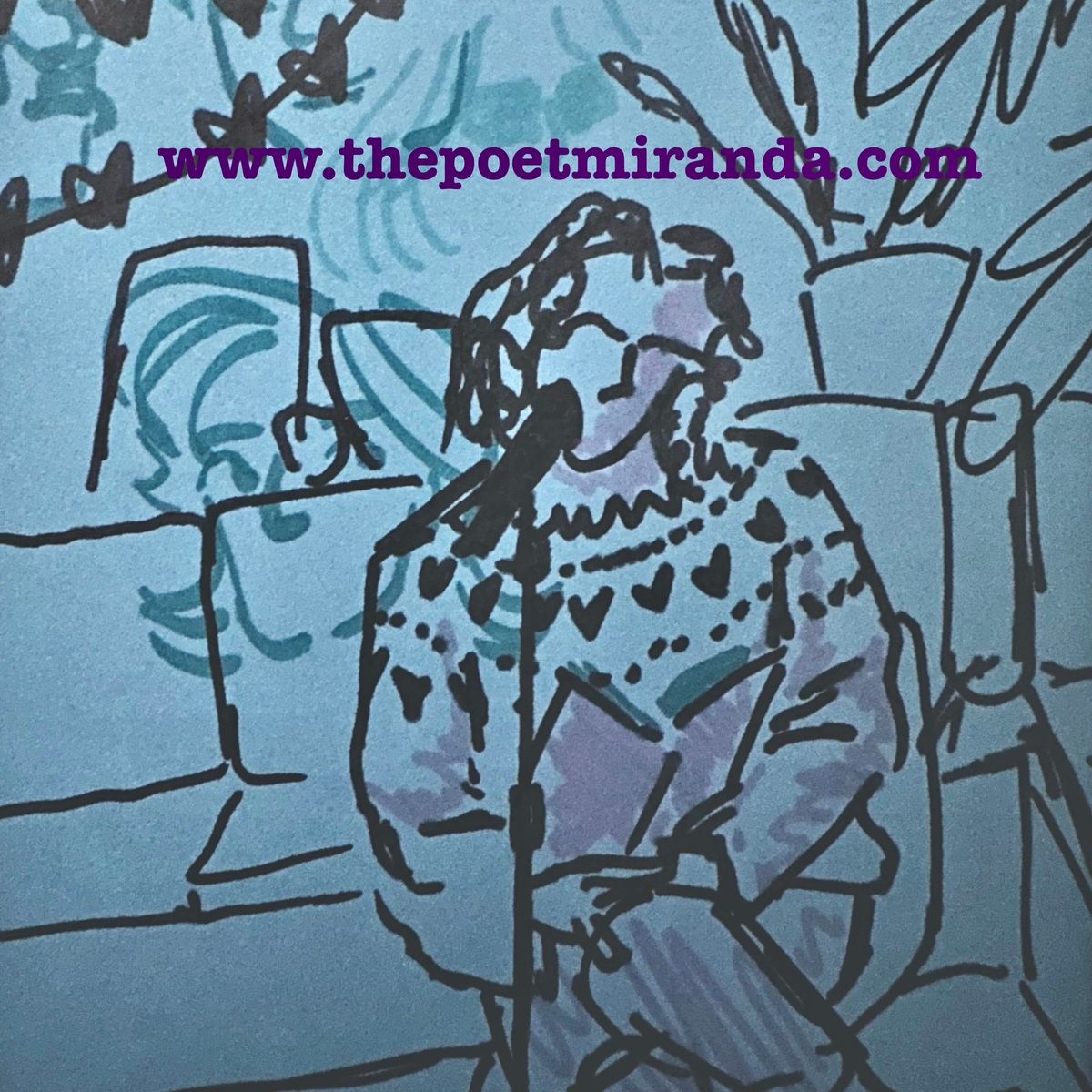
Across the room, near the stage where the sound system hummed its warm static between songs, Miranda had colonized a corner table with the focused intensity of a woman doing surgery. Three notebooks open, pens uncapped and arranged like instruments, the soft light falling on her face in a way that made her look like something from a painting somebody should have painted but didn't yet. She'd been at it when I came in and she was still at it now, the pen moving and stopping, moving and stopping, her lips barely visible in the motion of trying words before writing them.
Onyx had materialized across from her at some point—quiet arrival, loose leaf tea in one of the bar's mismatched mugs, steam rising in a soft thread—and was watching Miranda work with the particular attention of someone who recognizes another person's creative labor and knows better than to interrupt it but can't quite look away.
It's the containment, Miranda said finally, to the notebook, or to Onyx, or to the general atmosphere of the Sanctuary, the distinction unclear. The way they think the solution is always a box. Always some container they can stuff you back into and seal and put on a shelf where they don't have to see you move.
Onyx wrapped both hands around the tea mug and said nothing, which is often the most intelligent thing to say when Miranda is working.
I had a poem, Miranda continued, her voice taking on the half-distracted quality of someone thinking out loud, the syntax slightly off, searching. About exactly that. About the particular arrogance of people who think they can un-birth something real. And I want to find—not the poem again, I can't write the same poem twice—but the feeling underneath it. The feeling of being something they're trying to re-box after you've already escaped.
Those kids today, Onyx said softly. First words since she'd sat down.
Miranda looked up. Yes, she said. Exactly those kids. The court just handed someone a box. Here, put this child back in it. We've decided the box is the appropriate container for this particular existence. She let out a breath that was more controlled fury than exhalation. And the poem I want to write now is about what happens after. After the escape. After you're standing there in the open air and the boxes are still there and they're trying to build a new one while you're breathing. What does the escape artist do when the audience is hostile?
She performs anyway, Onyx said, barely above a whisper.
Miranda looked at her. Onyx was staring into the tea as if she'd surprised herself.
She performs anyway, Miranda repeated slowly, like she was tasting whether it would hold weight. She picked up the pen. Started writing.
Onyx looked up and caught me watching, and the expression that crossed her face was one I recognized—the complex embarrassment of someone who has accidentally said the true thing and doesn't quite know what to do with themselves afterward. I raised my glass an inch in her direction. She dipped her chin back, small and serious, and returned to her tea.

The door opened and Sarah came in like weather,
…that particular quality she has of filling space without performing the act of filling it—just present, immediately and completely, as if she'd been here the whole time and the door simply caught up. She got a beer from Miguel without conversation, the transaction of regulars, and found a spot at the bar near where Ezra had claimed their customary gravitational position, electric-silk hair catching the amber light, piercings doing their quiet work of declaring defiance.
Phoenix was beside Ezra, the purple-and-silver hair luminous, River next to them in scrubs that still smelled faintly of hospital, the particular green of tonight's shift the color of something living and institutional simultaneously. The three of them had been talking since before I arrived, a conversation with the texture of one that had started somewhere important and hadn't resolved yet.
Sarah settled in, sipped her beer, let a few minutes of conversation accumulate around her the way weather accumulates before it decides what it wants to do. Then, with the particular stillness of someone who has been thinking something for a long time and has finally decided the room is safe enough:
There are people, she said, who build themselves entirely from scratch. No map. No permission. No one holding the materials.
Ezra swiveled. Phoenix and River oriented with the slightly slower lean of people who recognize when a story has arrived without an announced beginning.
I mean people who— Sarah turned the beer bottle in her hands, label worn from the handling. The world around them spent decades insisting they were something specific. And they spent those same decades knowing, in some place underneath everything, that it was wrong. And they couldn't say it. Couldn't name it. Couldn't find one single person who would have understood the sentence if they'd tried to speak it. She paused. Do you know what that does to someone's architecture?
What do you mean, architecture? Phoenix asked.
The rooms, Sarah said simply. The rooms a person builds inside themselves when they have nowhere else to put what they actually are. When the outside world is— inhospitable— you go inward. You build. And some of those rooms get sealed because the only way to survive is to stop going into them. She sipped the beer. And then years pass. Decades. And the person is still there. Still standing. Carrying every sealed room, every piece of armor that calcified into skin because they wore it long enough. Still functioning. Still— here.
River was very quiet. Nurse-quiet, the quality of listening to symptoms.
This sounds like someone specific, Ezra said carefully.
Most true things are, Sarah said.
Are they okay? Phoenix asked, and the question came out younger than intended, cracked slightly at the seam.
Sarah considered this with the gravity it deserved. They're the kind of person, she said finally, who would tell you they're fine and mean it, and also be carrying something the size of a building at the same time, and not see any contradiction in that. That kind of— density. A small pause. I find it— I don't know. I find it worth believing in. More than most things.
That's not really an answer, River said.
No, Sarah agreed pleasantly. It isn't.
Phoenix was frowning slightly, the small crinkle of someone assembling pieces that keep coming out one short of the picture. River's eyes drifted across the room with the involuntary assessment of someone whose profession has trained them to look for sources of distress in every available space. Ezra was chewing their lip, running some internal calculation that hadn't resolved yet.
I was sitting seven feet away, watching them the way I watch most things at the end of a long day—without them knowing I'm watching, which is the only way anything real stays visible.
Keira had arrived quietly sometime in the last twenty minutes, taken the stool to my left, a book open in her hands with the comfortable authority of someone who can read in any environment because they've simply decided to. She was not, technically, listening to Sarah's conversation.
I kept my eyes on my cognac.
River was quiet in the booth beside Phoenix, coffee cup held in both hands, and the nurse-brain was already doing what it always did — cataloguing, sorting, running differential diagnoses on everything that didn't yet have a name. It was an occupational hazard. You spent enough years in triage and your mind started doing it without permission, cross-referencing symptoms against known conditions, ruling out the impossible and narrowing toward whatever remained.
Survived real things. Marks that don't get hidden but don't get performed either.
River had known Sage for over a year and Sage survived things quietly, but Sage's survival was interior, architectural — their marks were in their silence, not in the particular way Sarah had described, that thing about the armor and the private version being different. Sage didn't have a loud version. Sage was the same temperature in every room. River ruled that out.
Strong about who they are without announcing it. No performance required.
Miranda came to mind briefly — Miranda who had fought for every inch of herself in a world that wanted to audit her womanhood constantly. But Miranda's strength had a particular quality to it, luminous and explicitly poetic, and what Sarah was describing was something more — River searched for the word — compressed. Like force that had been through something and come out denser on the other side. And Miranda was married, so maybe not.
And the other one. The one they're with. Always aware. Lands like something inevitable.
River turned that one over. Thought about who in this room, or adjacent to this room, had that quality — the one where silence felt like accumulated understanding rather than absence. Elaine read sometimes but Elaine's silences were tactical, loaded with the next snarky observation. Julie talked more than she listened. Dani's attention was warm and present but she'd interrupt a moment to align her crystals.
There was someone, though. Someone River had watched over many months, sitting in this bar or near its edges, who had that exact quality — the book always open, the eyes that tracked everything, the words that arrived precisely when they were needed and not before. And beside that person, or because of that person, or inextricably wound into that person's life — someone else who matched Sarah's first description so completely that River's chest had done a small strange thing when Sarah said the loud version is the armor and the quiet version is the actual person.
River knew about armor. River had watched someone wear it and work through it and still be wearing parts of it on a nightly basis, standing at a bar or sitting on a stool with bourbon and television and the weight of everyone else's survival running through her like current through a wire.
River looked at Phoenix. Phoenix was writing again, not having worked through the same chain, or maybe having worked through it faster and deciding not to name it, which was its own kind of answer.
River looked at the bar.
Looked away.
Filed it. Not solved — not close to solved, because there were still pieces that didn't fit cleanly, still ways the description could fold in more than one direction. But the shape of it was becoming something. The outline of a thing. And River was good enough at outlines to know when you had enough edges to start imagining what the whole might look like.
Not tonight. Not out loud. But the mind, once it started running triage, didn't stop just because the bar was warm and the television was terrible and Phoenix was leaning warm against River's shoulder like something already answered.
I kept my eyes on the television. The yellow text on the red backdrop. The tanker in dark water. I picked up my glass and finished the last of the Elijah Craig slowly, the heat of it moving through me, and I did not say anything, and I did not have to.

The Pink Floyd came next through the speakers—Wish You Were Here, that particular wound of a song, two notes in the acoustic intro before the full thing settles into itself—and my chest did what it always does with that song, the involuntary tightening, the muscle memory of a small car on a Saturday morning, a child's voice finding the harmonies with a fearlessness that makes the present version of the song feel haunted.
I kept my face very still. Keira's hand didn't move to touch mine. That's not how we do things. But she reached and turned a page, which is close enough.
The cognac was almost gone. I didn't hurry it.

The thing about a day like today—the kind of day where a court sends a weaponized ruling down the pipeline and children in schools become targets in a geopolitical logic problem that was never actually about them—is that it doesn't announce itself as exceptional. It arrives alongside the ordinary machinery of existing: the coffee, the commute, the deployment pipeline, the email notifications. And then you sit in a basement bar that smells like rendered mercy and watch Erik explain the architecture of invisible suffering to a twenty-one-year-old who grew up in a town that never gave him language for it, and you watch Miranda reach for the words that could hold something as specific as the experience of being put back in a box after you have already escaped it, and you watch Sarah describe someone who built themselves in the dark and somehow came out of it still standing, still pouring, still keeping records—and something in you that had been tight all day begins to release, not because anything is resolved, but because you're not carrying it alone.
Della appeared from the kitchen with two plates she set down at the bar without being asked—blackened catfish, flash-cooked collards, a small ramekin of hot sauce that meant she'd been paying attention to someone's preference. She looked at my face with the particular diagnostic gaze of a woman who has been reading people through their plates for decades.
Eat something, she said.
I ate.
Later, when the bar had found its late rhythm, the conversations quieter and longer and more sprawling the way they get after the first drinks are finished and the pretense of just stopping by has dissolved—Gus leaned over and asked Erik something I couldn't hear exactly, and Erik's response made Gus laugh, surprised and genuine, the kind of laugh that doesn't know it's permission but gives it anyway.
Miranda had filled two pages. Onyx had ordered a second tea and was watching her with an expression of focused care, a quiet investment in someone else's work that costs more than it appears to.
Phoenix kept glancing at Sarah with the expression of someone who has almost solved something and isn't sure whether they want to complete the equation.
The Clash came through the sound system—Train in Vain, the kind of song that doesn't care what kind of day you've had, it's going to be loud and vital about it regardless—and for a moment the Sanctuary was exactly what it is: a pocket torn in the fabric of a world that's been trying to close every opening, a basement where eighty-five girls in a school in southern Iran are not just a statistic but a weight that sits in the chest of every person in this room, and the court ruling is not abstract policy but a direct threat to children who look something like the children in this room looked at twelve and thirteen, before they found their way down the narrow alley with the faded rainbow sticker, before they found the people who would hold their names and refuse to forget them.
I finished the cognac. Miguel materialized with the bottle, a questioning tilt of the wrist.
I shook my head. Some days you nurse the one glass. Some days the one glass is enough because what it carries is not the liquor.
Good night? Miguel asked.
Every night that ends down here, I said, is a good night. Relative to the alternatives.
He nodded with the gravity of a man who has poured enough end-of-day drinks to know that the bar is not a metaphor but an actual location where actual people set down actual weight, and that there is something real and irreducible and necessary about that function that no court ruling can legislate out of existence.
They keep trying to take the doors away, I said.
Miguel looked at me.
But people keep finding the stairs.
He put the bottle back under the bar, picked up his rag, and resumed the ancient bartender's work of making a space presentable for whatever comes next.
The Sanctuary breathed around us, warm and scarred and alive.
"The struggle of people against power is the struggle of memory against forgetting." — Milan Kundera
What happened today—in courtrooms, in airspace, in legislative chambers, in the deliberate erasure of scientific record—is the work of people who understand that power depends on forgetting. On children who can't name themselves in safe spaces. On scientists stripped from the record. On history revised until the revision becomes the only available story. The Sanctuary exists as counter-memory. Every name spoken here. Every story laid down on a barstool at the end of a hard day. Every young person learning that they are not alone, every poet reaching for the language to hold what the law keeps trying to make unspeakable. This is the work: not to forget, and not to let others forget. Memory is not passive. It is the oldest form of resistance available, and tonight, in a basement that smells like cognac and catfish and the particular resilience of people who refuse to be stored in boxes—it is enough. It is more than enough.

