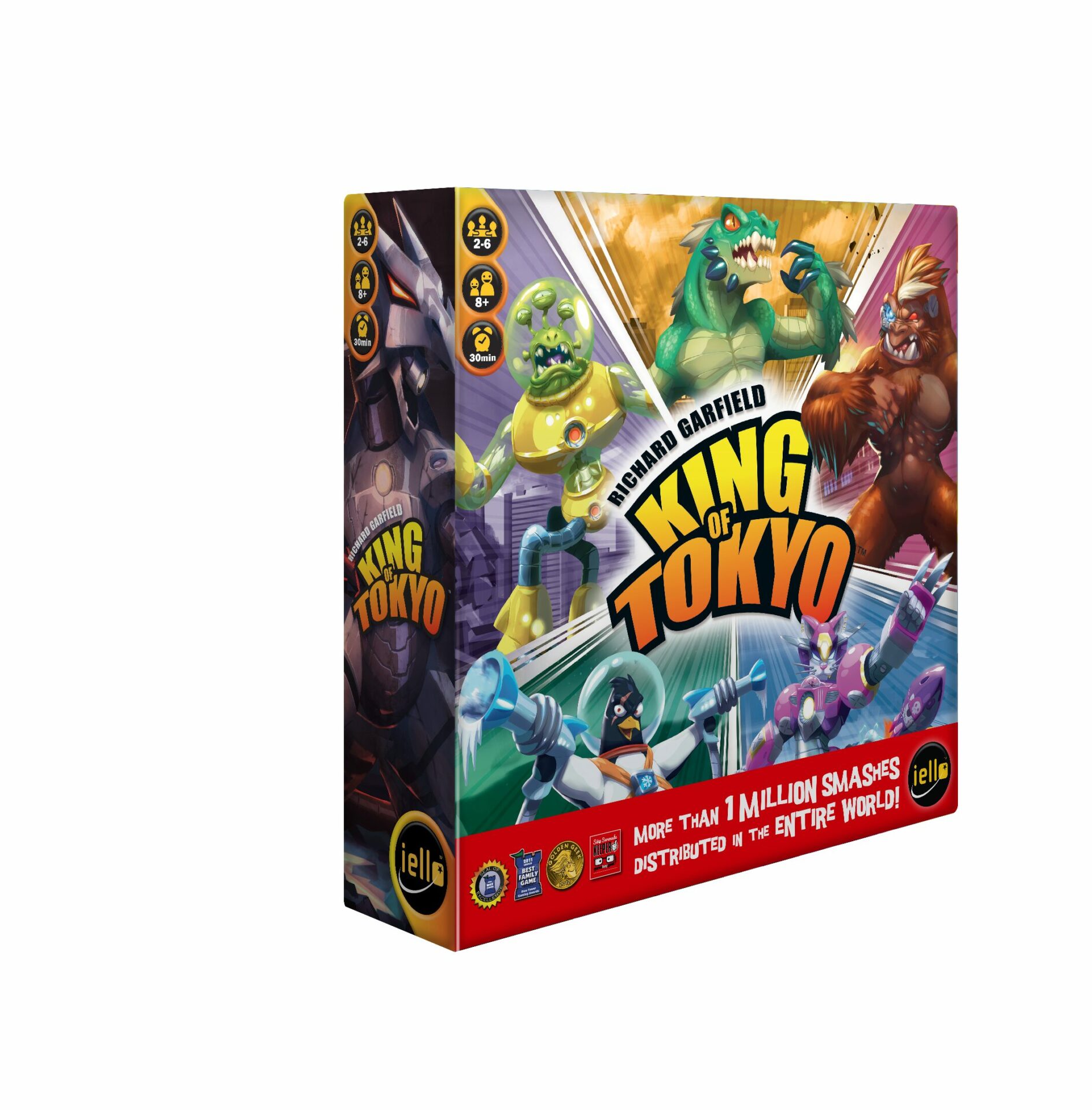
The six-sided die landed on a claw before I could breathe, and Sarah's hand came down on the table like a gavel sentencing someone to death by monster.
Claws again. Claws a-goddamn-gain.

king of tokyo play cards. credit: boardgamegeek forum
Her voice carried the fury of a woman who has been deconstructing the nature of randomness for forty minutes and finding it wanting. The Panda token sat in Tokyo Bay, accumulating victory points with smug inevitability. My Cyber Kitty crouched outside the city, nursing wounds, and Keira's Gingerbread Man had been quietly hoarding energy cubes like a survivalist stockpiling for the end of the world.
The basement air held that particular April weight — not quite warm, not quite anything. Someone had propped the alley door open with a milk crate and the smell of wet concrete mixed with whatever Della had sizzling in the kitchen, onions and brown butter, the sound of it underneath everything like a second pulse the building had grown. The walls sweated faintly near the ceiling where the old pipes ran, spring working its way underground.
Three tables tonight. Three different wars.
Miguel had caught me on the stairs coming down, pressing a glass into my hand with the precision of a man who'd been expecting me at exactly this moment. The Balvenie 14 Caribbean Cask caught the stairwell light like liquid amber — scotch finished in rum barrels, the smoke and the sugar fighting each other to a standstill somewhere in the middle of your tongue.
You look like you need the rum without the commitment, he'd said, wedding ring catching light as he turned back toward the bar where a chessboard waited.
I look like I need a different calendar year.
He'd laughed — that low, warm thing — and disappeared into the noise below.
Now I sat across from Sarah and beside Keira and the Balvenie sat beside my elbow and "Limelight" by Rush bled through the speakers with Geddy Lee's voice climbing toward something that sounded like a man trying to outrun his own visibility, and three tables held three different conversations about trust and strategy and chance, and outside, the world did what the world had been doing all week — which was nothing anyone in this basement wanted to name on a Sunday evening that was supposed to be about choosing your own rules for once.
Easter. Nobody said the word. But it sat in the room in the particular way certain people were present tonight who might otherwise have been elsewhere, at tables with blood relatives who still set places for versions of them that never existed. Dani had arrived with her scarves trailing, crystals already arranged on the bar in a half-circle. Erik had shown up still smelling of factory — Sunday shift, double-time, the kind of practical math that made the question of where you spent Easter academic.
The Panda rolled again. Three claws, a heart, and two energy.
Three energy, Sarah said, pulling cubes toward her pile with the deliberate satisfaction of someone counting ammunition. That's eight total. Which means—
Which means nothing, I said, and swept the power card row. Two energy spent. Three new cards turned face-up from the deck. I didn't even look at what I'd discarded.
The sound Sarah made was not a word. It was a frequency — something between a growl and the death rattle of patience that had been terminal for at least six turns. She'd been eyeing Extra Head since it appeared three sweeps ago. Before that, It Has a Baby. Before that, Bigger Brain. I had systematically removed every card she wanted from the market like a woman pulling weeds from a garden she had no intention of planting in.
Wendy. Wendy. Wendy. Sarah pressed her palms flat on the table, flannel sleeves rolled to the forearms, every word landing like a nail driven with philosophical precision. That is the fourth time you have spent energy — energy that could have gone toward actual strategic advancement — to reset cards that I was going to purchase. Do you understand that you are not winning? You are merely ensuring that I am not winning faster.
Exactly, I said, and sipped the Balvenie. The rum-barrel finish opened something in the back of my throat — warm, almost tropical, the ghost of Caribbean sun inside Scottish oak. It had no right tasting that contradictory and that correct at the same time.
Keira looked up from her Gingerbread Man's energy pile — twelve cubes, an obscene fortune she'd been accumulating while Sarah and I engaged in mutually assured destruction — and the look she gave me could have filed a police report.
You're supposed to be attacking her, Keira said. Not loud. Keira was never loud. But the words had edges, the kind that caught skin if you moved wrong. She's been in Tokyo for three turns. Three. She's gaining two points per turn just sitting there. You could have rolled claws and hit her instead of wasting energy on sweeping cards that—
The cards are the threat, I said. If she gets Extra Head, she rolls seven dice instead of six. If she gets Bigger Brain, she gets an extra reroll. If she gets It Has a Baby—
If she gets It Has a Baby, she gets a second pawn worth additional victory points, yes, I understand the goddamn card, Wendy. I've been watching you prevent her from buying it for thirty minutes.
Thirty-seven minutes, Sarah corrected, without looking up from the dice she was arranging in a row by face. I have been counting.
See? I pointed at Sarah. She's counting. She's always counting. That's why I sweep.
You sweep because you'd rather burn the village than let someone else farm it, Keira said, and something in her voice had shifted from frustration into genuine assessment. Meanwhile, I'm sitting here with twelve energy and nothing to spend it on because every time a good card appears, you incinerate the market before either of us can breathe.
I got It Has a Baby back, Sarah said quietly, and both Keira and I looked down at the three new face-up cards I'd just revealed by sweeping. There it was. Second position. The little cartoon monster spawning a miniature version of itself, worth extra victory points, grinning at us from the cardboard with the serene confidence of the inevitably reproduced.
Sarah reached for it. I reached for the energy to sweep again.
Don't you fucking dare, Sarah said.
Try me.
Wendy. Keira's hand landed on my forearm. Not hard. Not soft. Exactly the pressure required to make me feel the titanium plate beneath my skin. If you sweep one more time instead of rolling claws at her, I am going to ally with Sarah and we are both going to destroy Cyber Kitty, and I want you to understand that I am not joking.
The basement held the moment the way it held everything — with the casual patience of a room that had absorbed decades of standoffs between people who loved each other too much to back down and too fiercely to give in. A pipe somewhere above the pool table groaned, settling into the changed pressure like the building was taking a breath.
You realize, Sarah said, leaning back and crossing her arms — a posture that in Sarah meant the philosophical apparatus was fully engaged and somebody was about to get lectured into the ground — that your entire strategy is ontologically incoherent. You cannot simultaneously deny me resources and fail to advance your own position. That's not strategy. That's arson.
Arson gets results.
Arson gets you arrested.
Not if nobody owns the building.
I own the building, Keira said. I'm sitting here with twelve energy and the Gingerbread Man has eighteen victory points and if either of you looked at the actual board instead of whatever personal shit you're working out through cardboard monsters, you'd notice that I'm two turns from winning and neither of you has done a goddamn thing about it.
Sarah and I both looked at the board. Keira was, in fact, two turns from winning.
Well, shit, I said.
Well, shit, Sarah agreed.
So now you're allies, Keira said, and the smallest smile appeared on her face — the one she reserved for moments when the world arranged itself according to her calculations, which happened more often than was strictly fair. Funny how that works. Two rounds of you trying to destroy each other and I just sat here accumulating energy like a woman who understands that the loudest fight in the room is almost never where the real power is.
That was deeply patronizing, Sarah said.
That was deeply accurate, Keira corrected.
Both things can be true simultaneously.
And yet only one of them affects the scoreboard.
From the Spades table, Bubba's voice rolled through the room like weather.
Blind nil.
The declaration hung in the air. Then Ezra — blue hair electric under the lights, piercings catching reflections that moved like small rebellions — leaned back in their beanbag throne (they'd dragged it to the card table, because Ezra played Spades the way Ezra did everything, with the absolute confidence that the world would rearrange itself around their comfort) and said:
I got you covered. Anything you are worried about?
Yeah, I got one face card I am jimmied over. Bubba laughed.
Phoenix's mouth opened. Closed. Opened again.
Both of you? Again?
River, still in forest-green scrubs from a twelve-hour shift, the particular exhaustion of nursing sitting in their shoulders like something geological, looked at the scorepad and made a sound that was half laugh and half eulogy.
That's the fourth hand in a row where at least one of you has gone blind nil. The fourth. We are losing by three hundred and seventy points.
Three eighty, Bubba corrected, his massive frame making the folding chair beneath him look like a piece of furniture from a dollhouse. He didn't look up from his cards — except he wasn't looking at his cards, because he'd bid blind nil, which meant his cards were face-down, unseen, a declaration of trust so absolute it bordered on religious. We picked up the overtrick penalty two hands ago. Y'all at negative forty.
Negative forty, Phoenix repeated, their purple-and-silver hair falling across their face as they stared at the score sheet like it contained a medical diagnosis. River, we are at negative forty points in Spades.
I'm aware, love.
How are we negative? How is it mathematically possible to be negative in Spades?
Sand Bags, Ezra said cheerfully, passing four cards face-down across the table to Bubba. You keep taking tricks you didn't bid. You bid three, you take six, that's three bags. Ten bags, hundred-point penalty. Y'all have been bleeding bags like a busted pipe since hand two. Also— they paused, adjusting their position in the beanbag with the practiced grace of someone who had made comfort into a form of resistance — your signals are garbage.
We don't signal, River said, with the precise dignity of a nurse explaining a diagnosis to someone who was going to argue about it.
That's what I said. Ezra grinned. Your signals are garbage because you don't have any.
Bubba sorted through the four cards Ezra had passed him, arranging them into his hand with the deliberate patience of a man building something load-bearing.
Alright. I got a situation over here.
Good situation or bad situation?
Situational situation. I'm holding two face cards I don't love and a mid-spade that could go either way. If they lead anything below a jack in the first three tricks, I'm clean. If Phoenix does that thing where—
I don't do a thing, Phoenix said.
—where you lead the ace of hearts on the first trick like some kind of romantic kamikaze pilot—
It's a strong opening play!
It's a strong play if you're trying to lose, Ezra said. Which, based on the score, you are succeeding at with extraordinary commitment.
I hate both of you, Phoenix said, but the purple-and-silver hair couldn't hide the grin, and beside them River had already begun to deal the next hand with the efficient patience of someone who had accepted their fate and found it funny.
Okay, but seriously, Bubba said, lowering his voice to a register that somehow made conspiracy sound like weather, can you handle the first two tricks if I duck everything?
Duck everything? You want me to throw off on every trick? Why the fuck should I lead away from it like that?
I want you to not take a single trick for the first three rounds. After that I'll take over covering.
I can do that. I think. Unless they—
Don't think about unless. Just do it.
What if they lead your suit?
I don't have a suit. I went blind. I don't know what my suit is. That's the whole point of blind nil, Ezra.
Right. Right, right, right. Ezra tapped their cards against the table — a nervous gesture that contradicted every ounce of swagger they'd been projecting. Okay. I got you. Three tricks of nothing. Then I eat everything else.
That's my blue-haired, overcaffeinated, beanbag-sitting genius.
Stop flirting, Phoenix said to Bubba.
I'm not flirting, I was communicating. There's a difference and that difference is currently worth eight hundred points.
River snorted — the kind of laugh that escapes before you can decide whether it's appropriate — and looked at Phoenix with apologetic eyes.



"The Chain" by Fleetwood Mac crawled through the speakers — that bassline pulling itself hand over hand up from the bottom of an ocean.
And then the speakers shifted. "Don't Stop Me Now" exploded into the basement with the manic joy of Freddie Mercury declaring himself a shooting star, a racing car, a satellite out of control, and my hand stopped.
Mid-reach. Fingers open. The way a fist opens when the thing you were holding turns out to have been gone a long time and your hand just got the news. The titanium in my leg hummed a frequency that had nothing to do with barometric pressure and everything to do with a ten-year-old in the passenger seat of a Nissan Leaf screaming the high notes on the highway, both of us butchering the key change and nailing the joy.
Three seconds.
I picked up the wrong card. Looked at it. Put it back.
Nobody mentioned it. Sarah watched me with the patient stillness of someone who understood that some interruptions had nothing to do with strategy. Keira's hand was still on my forearm, and the pressure changed — not more, not less, just different. The pressure of someone who knew what the song meant and chose to say it through palm and silence instead of language.
Your turn, Sarah said, gentle in a way she would deny with philosophical rigor if anyone accused her of it.
I rolled. Two claws, a heart, three energy.
Attacking Tokyo, I said, and my voice worked fine. It worked fine.
At the chess table — the far corner, beneath the photograph of the bar's first Pride night stuck behind a bottle of Maker's Mark like a secret the building kept — Miguel and Grubby sat in the silence of two people communicating through wooden pieces on a sixty-four-square grid.
Miguel moved a bishop. Grubby studied the board. The game had been going for over an hour. Six pieces captured. Both players drinking — Miguel his usual mezcal, Grubby something amber that might have been bourbon or might have been tea, because Grubby's drink was Grubby's business.
Dani had positioned herself on a stool nearby, crystals arranged on the bartop in a configuration that looked like a small city of purple and rose quartz organized by someone who processed the world through pattern.
He's going to move the knight, she said quietly to Erik, who stood beside her with a bottle of Sweetwater 420 sweating in his grip, still in his work boots, the factory grease under his fingernails that no amount of Lava soap ever fully excavated.
He's going to move the rook, Erik said.
Miguel moved a pawn.
They both exhaled. Erik took a pull from his beer and the factory fell off him in degrees, the machinery noise fading, the conveyor-belt rhythm of his body unlocking joint by joint until he stood like someone who was just a person in a room instead of a man performing.
Long week? Dani asked.
They're all long.
This one specifically?
Erik drank again. The TV above the bar — muted, closed captions scrolling — showed something involving maps and arrows. Erik watched it for three seconds, then looked away.
Yeah, he said. This one specifically.
Dani didn't push. She turned a piece of amethyst between her fingers.
My kids asked me today why we don't go to Grandma's for Easter, Erik said. My wife's mom. She does the whole thing — ham, deviled eggs, that green bean casserole where the crispy onions on top are the only part worth eating. Seventy people show up.
And you can't go because—
I can go. I go every year. I pass fine. Nobody knows. Her mother thinks I'm just a regular-ass son-in-law who works at the factory and drinks too much beer on Sundays.
So what's the problem?
Erik looked at his beer. Looked at the muted TV.
The problem is my kid asked me why we don't go to Grandma's, and I realized I'd been standing in the bathroom for twenty minutes staring at my own chest trying to decide if the binder would hold under a polo shirt in Georgia heat for six hours, and the answer was no, it wouldn't, and the backup answer was a compression shirt that makes me sweat through everything by hour two, and the backup to the backup was just going in a loose t-shirt and praying nobody looked too hard, and somewhere in the middle of all that math my seven-year-old is standing in the doorway asking me why Daddy looks sad.
Dani set the amethyst down.
What did you tell her?
I told her Daddy's fine and we're going to the park instead. Because the park doesn't require chest logistics.
You brought your family here instead of to the park.
We went to the park. Then the park got exhausting in a different way. Then my wife told me to go be with my people for a few hours and she'd handle bedtime. Erik finished his beer. She says that sometimes. 'Your people.' Like she's giving me permission to go to church.
Maybe she is, Dani said. Maybe that's exactly what she's doing.
The world outside pressed against the basement walls. You couldn't see it, but you could feel it in the way the room breathed, in the faint dampness near the ceiling.
Should I Stay or Should I Go punched through the speakers — The Clash, Mick Jones asking the question that every person at every table was answering differently tonight — and from the Spades table, Ezra whooped.
Nil made! Both of us! Read it and weep, children.
That is not possible, Phoenix said, but they were smiling. You can't both make nil every hand. The math doesn't—
The math does exactly what we tell it to, Bubba said, and wrote the score down with the care of a man inscribing something sacred. We're at 670. Y'all at—
Don't say it, River said.
—negative sixty.
He said it. Phoenix turned to River. He said it and he smiled. Did you see that? Bubba smiled. I've known that man for almost a year and I've seen him smile maybe four times and one of them is because we are losing at Spades by seven hundred and thirty points.
Seven thirty's a lot of points, cher.
And there it was — cher — in Bubba's mouth, borrowed from Remy the way lovers borrow each other's language without knowing they're doing it. The whole table heard it. Nobody said anything.
Della emerged from the kitchen carrying a plate that smelled like garlic and chorizo and cast-iron alchemy. She set it between Erik and Dani.
Eat, she said. One word. The entire gospel of Della in a single syllable.
What is it? Erik asked.
Food. Put it in your mouth. The part where you identify it is not required for the part where it keeps you alive.
It smells like my grandmother's kitchen, Dani said, and something in her voice caught on the word grandmother the way fabric catches on a nail — a small snag that held more weight than the material could explain.
Then your grandmother knew what she was doing. Eat.
Della, is this the chorizo from the new place on Buford Highway?
That chorizo is from a man named Tomás who drives a truck that doesn't have working brake lights and sells out of a cooler in a parking lot behind a nail salon, and his chorizo is better than anything you'll find in a store with a health inspection certificate, and no, I will not tell you which parking lot because you will ruin it by telling everyone and then Tomás will raise his prices and I will have to murder you.
That's fair, Erik said.
Damn right it's fair. Miguel! She turned toward the chess table. You eating tonight or are you just going to sit there staring at a pawn like it owes you money?
I'm thinking, Miguel said, not looking up.
You've been thinking for forty-five minutes. The pawn is not going to reveal the meaning of life. Move it or don't. Grubby, tell him to eat.
Grubby looked at Della, then at Miguel, then back at the board, and said nothing, which was itself a form of communication that Della received, interpreted, and dismissed in approximately half a second.
Useless. Both of you. I'm making more. She disappeared back into the kitchen and the sizzle resumed.
Who's winning over there? Della called toward the Spades table.
Justice, Ezra said.
Us, Bubba clarified.
Same thing, Ezra said.

At our table, Sarah had finally acquired Bigger Brain while I was busy rolling claws and Keira was busy being correct about my strategy. The extra reroll changed the game — Sarah's dice fell differently now, the Panda accumulating points with the quiet efficiency of someone who understood that patience was a form of violence.
This, Sarah said, placing the Bigger Brain card beside her monster board, is what happens when you stop letting Wendy play defense and start playing your own game.
I let her have that one on purpose, I said.
You let her have it because you ran out of energy to sweep, Keira said.
Same thing.
It is exactly not the same thing, and you know it, and the fact that you're smiling right now tells me you know I know you know it—
I'm smiling because I love you.
You're smiling because you're full of shit and the Balvenie is going to your head and Sarah is going to win this game because you spent every resource you had making sure she couldn't win comfortably instead of trying to win yourself.
She wasn't wrong. The Balvenie was going to my head. The rum-barrel sweetness had settled into something deeper — the smoke becoming a room, the sugar becoming a window letting in light from somewhere you'd never been but recognized anyway.
Grubby moved a knight. Miguel looked at the board for a long time, then moved a pawn one square forward, and the two of them sat in a silence that had weight and texture and the particular quality of a conversation happening in a language that predated words — the language of position, of sacrifice, of knowing which piece to risk and which to protect and understanding that sometimes the most important move was the one that looked like nothing at all.
Roundabout by Yes crept into the room — that organ intro spiraling upward like something ancient emerging from the floor, the whole song unfolding with circular patience.
The night wound itself down the way game nights do — not with a decisive ending but with a gradual loosening, the competitive edges softening into the particular exhaustion of people who had spent several hours caring intensely about things that didn't matter in order to rest from the things that did. Sarah won King of Tokyo by six points. She explained at length why her victory was philosophically inevitable, then bought the next round.
For the record, she said, sliding the Panda token across the table with one finger, I would have won by twenty if you hadn't swept the deck as often. The Bigger Brain was a consolation prize. I want that on the record.
Noted, I said.
And the other cards, you kept sweeping the board. I counted.
You always count.
Someone has to.
Keira told me she'd forgive me if I promised never to sweep a market again. I made no such promise. She kissed my cheek — quick, surgical — and I felt it in the titanium, in the nerve, in the fire that lived in my spine.
Phoenix and River lost Spades by eight hundred and ten points. They did not appear to care. They sat shoulder to shoulder after the last hand, River's scrubs against Phoenix's jacket, and Phoenix turning the ruby ring on River's finger the way you turn a prayer bead — not for luck but for the sensation of touching something that meant you were tethered to another person by choice, by want, by the specific gravity of deciding that someone's hand was where your hand belonged.
Six more days, Phoenix said, quiet enough that I almost didn't catch it from across the room.
Six more days, River said. You nervous?
Terrified.
Good. If you weren't terrified, I'd worry you weren't paying attention.
Is Wendy going to make me cry during the ceremony?
Wendy is going to make everyone cry during the ceremony. That's what she does. She exists to make rooms full of people feel things they didn't authorize.
I heard that, I called from the King of Tokyo table.
You were meant to, River called back, and the smile on their face — exhausted, twelve-hour-shift-hollowed, still in scrubs that smelled of hospital soap and someone else's emergency — was the kind of smile that made you understand why people used the word radiant, even though radiant was a word I'd trained myself to distrust.
Six days. The wedding was six days out and the whole bar knew it and the whole bar held it like a collective breath, like something precious balanced on an edge, like the moment before music starts when the room is all potential and no sound.
Miguel and Grubby's chess game ended in a draw by mutual agreement, both too deep into their drinks to calculate more than two moves ahead.
Same time next week? Grubby asked. Their voice was the rare thing it always was — quiet, carrying weight inversely proportional to volume.
Same time every week, Miguel said.
Grubby's hand shook slightly when they shook Miguel's, and Miguel held it a beat longer than necessary, and the basement light caught them there — two people who had found a way to be silent together that felt more like conversation than most conversations.
I finished the Balvenie. The last sip was all peat and memory — the sugar gone, the smoke remaining, the way the end of anything honest leaves you with what was true. The condensation ring it left on the bartop would be there tomorrow, another ring in the archaeology of a room that kept everything.
The milk crate held the door open. April air came down the stairs carrying the smell of a city trying to be spring, dogwoods probably blooming somewhere above us in the dark, the whole city reaching upward while we sat below it in a room that understood that sometimes the most revolutionary act available was a Sunday evening spent rolling dice with people who knew your real name and called you by it without flinching.
"Queerness is essentially about the rejection of a here and now and an insistence on potentiality or concrete possibility for another world." — José Esteban Muñoz
Three tables. Three games. Three sets of rules nobody imposed on anyone else. In a week where the world above kept changing the rules without warning — moving pieces that weren't theirs, calling blind on hands they hadn't dealt — this basement held steady with the radical simplicity of chosen agreement. We picked our monsters, our partners, our positions on the board. We fought like hell within the boundaries we'd built together. And when it was over, we bought each other drinks and the room absorbed one more evening into its walls, adding another layer to the archaeology of a place that existed to prove that the most powerful rules are the ones freely given and freely kept.

